We Design Your Financial Destiny


(Precious) Words of Wisdom : "Wall Street makes its money on ACTIVITY, you make your money on INACTIVITY." ~ Warren Buffett
Showing posts with label Loans. Show all posts

The EMI Trap: How Young Indians May Break Free From Debt

break-free-from-debt

Easy credit, endless EMIs, and social media pressure are creating a financial mess. Here's how to break free.


Once upon a time, Indians borrowed money to buy a house.

Today, we borrow money to buy headphones, sneakers, concert tickets, protein powder, and occasionally, a coffee machine sophisticated enough to launch satellites.

Welcome to modern India, where "Buy Now, Pay Later" has become less of a payment option and more of a lifestyle choice.

Young Indians are drowning in debt, and the scary part is that many don't even realize they're underwater. The monthly EMI has become so normal that people proudly announce, "I only have seven EMIs running right now," as if they're discussing fitness goals.

The problem isn't that debt exists.

Debt can be useful. A home loan can help buy an appreciating asset. An education loan can boost earning potential. A business loan can create opportunities.

The problem is that we've started financing wants as if they were needs.

A Rs.1,20,000 smartphone on EMI of Rs.10,000 somehow feels cheaper than a Rs.30,000 phone paid upfront. A weekend trip booked on credit feels affordable until three months later when you're still paying for cocktails you no longer remember drinking.

The result?

An entire generation earning far more than their parents did at the same age...yet feeling financially stressed all the time.

How did we get here?
First, credit has become ridiculously easy.

Previous generations had to fill forms, visit banks, submit documents, wait for approvals, and sacrifice a goat to the banking gods.

Today, a loan can be approved faster than a food delivery order.

Second, social media has weaponized comparison. You aren't competing with your neighbors anymore. You're competing with influencers vacationing in Bali, entrepreneurs driving luxury cars, and fitness coaches who somehow own three watches worth more than your annual salary.

The pressure to "look successful" often arrives years before actual success.

Third, nobody teaches money management. Schools spend years teaching trigonometry and calculus. Yet millions of graduates enter adulthood without understanding compound interest, credit card debt, budgeting, or investing.

Many young professionals know how to calculate the velocity of a moving object but not the interest rate on their credit card.

This is indeed tragic.

So how do we fix the problem?

Solution 1: Make Debt Boring Again

The financial industry works hard to make borrowing feel exciting.

Zero-cost EMI!
Instant approval!
Pre-approved offer!
Exclusive limit increase!

Notice how nobody advertises debt the way it actually works: "Caution! Are you ready to commit your future income to present consumption?"

Not quite as catchy.

Before taking any loan, ask a simple question: "If I had to pay the full amount today, would I still buy this?"

If the answer is no, the EMI isn't making it affordable. It's making it easier to ignore the cost.

Solution 2: Follow the 24-Hour Rule

Most bad financial decisions are emotional decisions.

You're bored.
You're stressed.
You're feeling left out.

Then suddenly you're buying limited-edition sneakers using a payment plan that lasts longer than some relationships.

For any non-essential purchase above a certain amount, wait 24 hours.

That's it.

A shocking number of "must-have" purchases become "why was I even considering this?" purchases after one night's sleep.

The human brain is many things.

Rational at midnight during an online sale is not one of them.

Solution 3: Automate Investing Before Spending

Most people invest whatever money remains at the end of the month.

Which is adorable.

Because, by then, usually it's nothing but zilch.

Instead, reverse the process.

The day your salary arrives, automatically transfer money into investments first. Mutual Funds. Fixed Deposits. Gold ETFs. Whatever fits your goals.

Then spend what's left.

This creates a powerful shift. You're no longer trying to save after spending. You're spending after saving.

Small difference. Massive results.

Solution 4: Stop Buying Status, Start Building Wealth

This may be the hardest lesson of all.

Many purchases aren't about utility. They're about signaling.

The expensive phone.
The luxury watch.
The premium gym membership you visit twice a month.
The fancy car parked outside a rented apartment.

The goal isn't always ownership. It's appearance.

But here's the irony: truly wealthy people focus on assets. People trying to look wealthy focus on liabilities.

One group buys investments.

The other buys monthly payments.

Guess which group sleeps better.

The Bottom Line
Debt isn't evil.

But debt used carelessly is like hot sauce: a little can improve life, too much can ruin your evening.

Young Indians don't have an income problem nearly as much as they have a consumption problem disguised as an income problem.

The solution isn't earning more. Plenty of high earners are broke. Whereas some housewives have become millionaires.

The solution is becoming intentional. Because financial freedom isn't about buying everything you want.

It's about reaching a point where your future salary already belongs to you—not to a dozen EMIs, three credit cards, and that regrettable impulse purchase from a midnight sale.

And in a country where instant credit is only one click away, learning to say "no" might just become the most valuable financial skill of all.


If this article resonated with you, I'd strongly recommend investing in knowledge before spending Rs.50,000 on your next gadget. 
The Psychology of Money by Morgan Housel is one of the best books on understanding why smart people make terrible money decisions—and how to build healthier financial habits. It's a quick, engaging read that might save you from years of expensive money mistakes.

Are You Just One Bill Away From Medical Bankruptcy?

health-cover-or-medical-bankruptcy

Let’s start with three uncomfortable but unavoidable facts:

Fact No. 1: Health issues are multiplying faster than WhatsApp forwards.
Fact No. 2: Healthcare expenses are ballooning like the budget of a big, fat Indian wedding.
Fact No. 3: Health insurance premiums are swelling every birthday—like a belly after one too many cheat days.

Result:
One serious illness in the family can single-handedly demolish your net worth, your emergency fund, and your belief in “I’ll manage somehow.”

This is why health insurance is not just health insurance.
It is also wealth insurance.

Buying Basic Health Insurance Is Just the Trailer, Not the Movie

Many people think:

“I’ve bought a health insurance policy. Job done.”

Wrong.

That’s like buying a lock for your door and assuming your house has Z-plus security and NSG on speed dial.

In reality, surviving medical inflation requires a multi-layered defence system—not a single policy bought in panic after reading a scary tweet.

Let’s build this system properly.

The 5-Layer Protection Plan Against Medical Bankruptcy

Layer 1: Basic Health Insurance Cover

This is your foundation.

Buy a standard indemnity-based health insurance policy, where the insurer pays your actual hospitalization expenses (subject to limits, exclusions, and fine print written in microscopic font).

For a normal family with no alarming medical history, a cover of Rs.5-10 lakhs can usually handle routine hospitalizations.

This is the first wall. Necessary, but not sufficient.

Layer 2: Super Top-Up Policy

Here’s where most people get smart—or regret not doing so.

Costs for serious or prolonged illnesses can easily touch Rs.10–50 lakh. Buying a base policy for such a huge cover is expensive.

Instead:
Same protection. Much lower premium.
This is your second line of defence, and an absolute must.

Layer 3: Critical Illness Cover

Regular policies handle hospital bills.
Critical illness policies handle financial shock.

Cancer, heart attacks, strokes, kidney failure—these don’t just cost money, they cost time, income, and sanity.

Critical illness cover pays a lump sum, regardless of actual hospital bills. You can use it for:
  • Loss of income
  • Recovery
  • Lifestyle adjustments
  • (and also) Treatment
A Rs.20-50 lakhs Critical Illness Cover is your shield for such worst-case scenarios.

Layer 4: Daily Hospitalization Plans

No policy covers everything.

There are always “uninsured” expenses:
  • Attendant costs
  • Travel
  • Food
  • Sundry charges hospitals invent creatively
A daily hospitalization plan pays a fixed amount per day of hospital stay, helping you manage these leaks.

Optional? Yes.
Useful? Also yes—if affordable.

Layer 5: Your Own Health Corpus

Here’s the grown-up truth:
Relying 100% on insurance is risky.

Premiums rise with age. Policies change. Renewals become expensive. Managing multiple covers becomes tiring.

That’s why you must build a health corpus—your own pool of money, just like a retirement fund.

This corpus:
  • Absorbs part of medical costs
  • Reduces dependence on insurance
  • Protects your long-term investments
Insurance + personal corpus = sustainable strategy.

Final Reality Check

No financial security system is perfect.

But planned protection beats blind optimism every single time.

Given:
  • The rising threat of medical emergencies
  • The scale of potential financial damage
Complacency is not an option.

Protecting your health is important.
Protecting your wealth from health-related shocks is critical.

Don’t let medical bills catch you off guard—‘Sick Business’ by Dr. Sumanth C. Raman reveals the hidden costs of healthcare in India, and a why 'smart health insurance plan' matters...a lot.


(Disclaimer: Some links in this article may be affiliate links.)


Moksha Lies in Money Gyaan – Master Financial Literacy Today

financial-literacy

Pyaare bhakton - and those still calculating their credit card bill minimum amount due:

Welcome to Arthik Gyaan Sabha.

Close your Amazon cart, mute that Zomato notification, and listen carefully.

Because today's pravachan can save you from poverty faster than any baba's magical yantra.

Let me start with the ultimate truth of Kaliyug:
Knowledge is power.
Money is survival.
And knowledge about money? That, my friends, is moksha.

For in today's India, ignorance is not bliss — it is bankruptcy with 40% GST added.

First Pravachan: The Golden Past of Guaranteed Returns

Once upon a time, our fathers and grandfathers slept peacefully. Why?

Because they had LIC endowment policies, Post Office schemes, and fixed deposits that behaved like obedient sons. 'Put money today, get double-digit guaranteed returns tomorrow' — simple as dal-chawal.

But those golden days are gone. 

The guarantee nowadays has fallen to low single-digit yields. Banks change FD rates more often than our netas change parties. Even the Post Office schemes are linked to G-sec rates and can change every quarter.

The nirvana today lies in embracing the unpredictability and uncertainity.

And yet, what do many Indians do? They avoid equities and mutual funds 
— the most 'predictable' wealth creators — like they avoid vegetables at a wedding buffet.

Listen carefully: financial literacy today is like learning to read the pitch before batting. Otherwise, one googly from the market, and you'll be clean bowled — standing there like a confused debutant blaming 'system kharaab hai.'

Second Pravachan: The Temptations of Consumption

Now, let us turn to the great modern mandir: the shopping mall. Or, if you're too lazy to get out of your sofa, the temple of Amazon, Flipkart, Myntra.

Once upon a time, shopping was an event.

Twice a year — Diwali and maybe a cousin's wedding — you bought clothes. Today, every day is Big Billion Day. Free delivery, one-day delivery, 10-minute delivery — arre bhai, even Hanuman ji took more time to bring Sanjeevani!

And of course, every week there's a new mobile model. Why?

Because your old phone, bought merely six months ago, is now supposedly 'outdated.' Clothes change faster than film stars' marriages, and home décor upgrades are advertised like prasad from Tirupati.

But remember, my disciples: if you don't put a budget laxman rekha around your spending, your wallet will vanish faster than prasad after an aarti.

Financial literacy here means knowing when to splurge, when to save, and when to say 'bhaiya, bas ek kilo aloo dena.' Otherwise, welcome to the Great Indian Vanishing Money Trick — salary credited at 10 AM, balance zero by evening.

Third Pravachan: The Maya of Easy Finance

And now, the greatest modern illusion — Easy Finance.

In our parents' time, the word 'loan' was like Raavan: the one who must be dreaded. Borrowing money was considered worse than failing board exams. Forget holiday loans, even for a scooter you needed to beg, plead, and produce character certificates.

But today? Banks, Apps, NBFCs — everyone is dying to give you a loan. Want a vacation? Loan. Want a fridge? Loan. Want to buy sneakers worth '15,000'? Madam, just three easy EMIs!

Borrowing has become as normal as ordering chai. And thanks to 'affordable EMIs,' many youngsters think, 'arre, kya farak padta hai.' But let me tell you, when half your salary goes to EMI, you will realize farak padta hai — and kaafi padta hai.

So hear this truth: loans are not evil. But borrowing blindly is like eating 10 plates of pani puri — you won’t feel it at first, but later you will regret it with full force.

Financial literacy teaches you when to borrow, how much to borrow, and when to firmly tell the loan agent, 'nahin, mujhe credit card nahi chahiye.'

The Closing Aarti of Financial Wisdom

So, my dear congregation of swipers and spenders, here is aaj ka money gyaan:
The financial world is not a garden, it is a minefield. Step correctly, and you may grow wealth. Step wrongly, and boom — you're in financial ICU.

That is why, apart from IQ (Intelligence) and EQ (Emotion), you need FQ — Financial Quotient.

Without it, you'll be like that poor soul who invests in 25-year insurance plan for 'tax saving' and receives below-savings-account-interest-rate as returns.

Remember the words of sage Benjamin Franklin: 'An investment in knowledge pays the best interest.'
And I, your humble desi preacher, shall add: 'An investment in ignorance pays only EMIs.'

So go forth, budget thy spending, review thy investments, and control thy borrowing.

May Dhanlakshmi bless your savings.
May Kuber protect your portfolio.
May you never fall for 'zero down payment' traps.

Om sampati, sampati.


How To Become Incredibly Rich (Without Robbing A Bank)

how-to-become-rich
If you're reading this, it's probably because you've had one too many failed attempts at bank robbery.

Or perhaps you've realized that, walking into banks with guns and gunny bags, aren't exactly the keys to financial success.

Well, you've come to the right place. Herein you won't find any blueprints for elaborate heists or tips on how to outsmart the police. Instead, this guide will help you build wealth the right way, without any need for ski masks, getaway cars, or illegal activities.

So, put down that black and white striped shirt, and let's dive into 10 actionable steps to amass wealth and create a financially secure future — without stepping foot into a bank vault!

1. Invest in Financial Lesson Before You Invest in Stocks

Before you start throwing money at stocks or mutual funds, like you're in a game of financial darts, maybe consider a crash course in 'How Not to Trip Over Your Investments 101'. A solid understanding of how to manage money and investments is crucial for long-term success. Trust me, your wallet — and your financial dignity — will thank you!

Actionable Tip: Take a course or read books on personal finance and investing to learn how to manage money wisely.

2. Seek Expert Guidance from a Financial Mentor

Before you dance with the rupees like no one's watching, get yourself a seasoned guide – because let's face it, even Bollywood actors need choreographers to create memorable hook-steps! Consider hiring a financial mentor or advisor who can guide you through the complexities of wealth-building. Think of it like hiring a coach to help you navigate financial decisions with confidence.

Actionable Tip: Find a Financial Planner who can provide personalized advice based on your unique goals.

3. Follow a Detailed Financial Roadmap

Let's be real, navigating money matters without a map is like trying to find your way through a labyrinth blindfolded – not recommended unless you enjoy bumping into walls and tripping over metaphorical financial banana peels! Establish a detailed financial roadmap to guide your decisions and ensure you're staying on track toward achieving your goals.

Actionable Tip: Set clear, achievable financial goals and break them down into smaller steps to make the journey smoother.

4. Don't Copy Others. Invest In What Works For You.

Why settle for being a copycat when you can be the Picasso of your own life? Embrace your uniqueness because, let's be honest, the world doesn't need another wannabe – it needs the unapologetically original you! Be authentic in your investment strategy. While others may get rich through real estate, stocks, or crypto, your success will come from doing what works best for you.

Actionable Tip: Research different investment strategies and choose the ones that align with your risk tolerance and goals.

5. Beware of Scams and Fraud Investment Schemes

The financial world is filled with scams and deceptive schemes. Avoid falling victim to "get rich quick" promises and always do your due diligence before making any investment. No one's going to give you the key to riches, while s/he earns a measly commission. Protect your wealth from fraud.

Actionable Tip: Always verify the legitimacy of any investment opportunity, and if it sounds too good to be true, it probably is.

6. Don't Borrow More Than What You Can Digest

Being over leveraged is like trying to impress at a buffet by piling your plate to the ceiling – it might look impressive at first, but it's a disaster waiting to happen, and everyone's just waiting for the crash! Avoid borrowing beyond your means, as it can lead to financial ruin.

Actionable Tip: Stick to a budget and avoid taking on excessive debt. If you need to borrow, do so cautiously and with a clear repayment plan.

7. Always Pay Your Credit Card Bills Before Due Date

Paying your credit card bills on time is crucial to maintaining a strong credit score and avoiding unnecessary late fees. Staying on top of your bills is one of the easiest ways to maintain financial health.

Actionable Tip: Set up automatic payments or reminders to ensure you never miss a due date.

8. Keep Your Finances Simple

In the grand opera of life, nobody wants to deal with unnecessary plot twists and financial acrobatics. Simplicity is key to success. Avoid getting caught up in complex, high-risk investments that are hard to understand. Keep your investment strategy simple, and focus on what you can control.

Actionable Tip: Use basic investment / insurance strategies like index funds / term insurance plans to keep things straightforward and low-maintenance.

9. Avoid Exotic Financial Products and Derivatives

Your money shouldn't be taking a vacation in the Bermuda Triangle of investments. As Warren Buffett also warned 'Exotic financial products and derivatives are weapons of mass financial desrtuction'. They often come with high risk and little reward. 

Actionable Tip: Say NO to derivatives such as Futures & Options, Credit Default Swaps, etc.

10. Start Early, Invest Regularly, Stay Committed

In the thrilling rollercoaster of wealth-building, it's not about the speed; it's about the persistence. Think of it as the 'slow and steady wins the financial race' strategy, with less sweat and more laughs along the way!  The earlier you start investing, the more time your money has to grow. Consistently invest, stay committed, and don't panic when the market dips.

Actionable Tip: Start investing as soon as possible, even if it's just a small amount, and increase your contributions over time.

Conclusion: The Path to Wealth Without Crime

Well, dear reader, we've reached the end of our roadmap to riches without ever donning a mask or casing a bank. And, if you're still contemplating robbing a bank after reading this, you might need to consult a different type of expert — one with a badge and a pair of handcuffs.

But for the rest of you, those who've embraced the idea that wealth doesn't require a life of crime, I raise my metaphorical hat to you. You've recognized that the true treasures in life are found in smart investments, hard work, and a dash of financial savvy, not in a bag of ill-gotten loot.

As you embark on your journey to financial success, remember the key lessons — investing in education, seeking expert guidance, and staying disciplined — we've covered. Whether it's investing wisely, saving diligently, or just finding joy in the everyday moments, it's all part of the grand adventure of life. And hey, if you happen to stumble upon a treasure map or a pot of gold at the end of a rainbow, consider it a bonus!

Finally, a few words of wisdom from my personal experience: Go forth, my fellow wealth-seekers, and remember that the richest people in the world aren't the ones with the biggest bank vaults, but those who've discovered that true wealth lies in a life well-lived, filled with laughter and the occasional smart investment.

Wishing you a future as bright as a vault full of gold, minus the risk of prison time.

Gold Loan Industry Development Phases

This guest post is contributed by Renisha Chainani, Head - Research, Augmont Goldtech Pvt. Ltd.

Gold has not only maintained its status of "store of value" for over 5,000 years but also preserved its purchasing power. Gold is a highly liquid asset and customers can easily use it to satisfy their liquidity needs. Loans are provided by lenders who secure gold assets as collateral. In India, the gold loan market is big business compared with the rest of the world. India is one of Gold's largest consumers with an estimated cumulative stock approaching 25000 tonnes, of which 65 percent belong to the rural population1. Because of the household jewellerys' emotional value, people rarely sell their gold to meet their immediate financial needs. However, people pledge their ornaments as collateral, as an alternative, and secure short-term loans.

At a broad level, the lenders of gold loans are classified into two main categories: Organised and Unorganised. Because gold loans are granted against the gold pledged by borrowers, the amount of gold available to customers is a key parameter when determining the size of gold loans on the market. For centuries, money lenders and pawnbrokers have provided gold loans to people from all walks of life. Currently, the Unorganized Gold Loan market in India is estimated to be close to 65 percent of the total market for gold loans. Unorganized players provide quick gold loans with little documentation but at a very high-interest rate, with their local market knowledge. Customers are at risk of exploitation by these players because they are totally unregulated.

Until two decades ago, most of the lending was through pawnbrokers and money lenders in the unorganized sector. However, this scenario is changing with the arrival of organized players in the sector, such as banks and non-bank finance companies (NBFCs), which now command over 60 percent of the market. The organized market for gold loans has grown by more than 30 percent between 2010 and 20192.

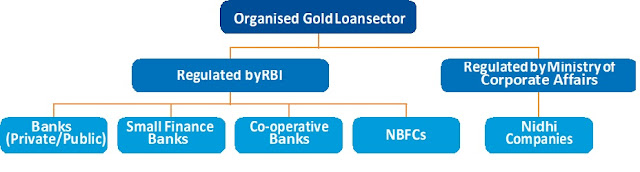
Outstanding total gold loans in the organized sector in 2019 are estimated at 5.5 percent of India's total household gold holdings, indicating a low market penetration. Gold loan demand is projected to hit new heights, however, with the ease in monetizing gold and enhanced economic development in rural India. In the meantime, the organized market for gold loans comprising banks (public, private, small finance and co-operative), Non-Banking Financial Company (NBFCs) and Nidhi companies contribute to nearly 35 percent of the Indian gold loan market.


gold-loan-industry

Owing to its large network, quicker turnaround time, higher Loan-to-value (LTV) ratios and the opportunity to service non-bankable customers, NBFCs were a big driving force behind this development. The comparative advantage in this industry is that the average tenure in gold loans is at an average of 4-5 months3, which means strong receivables for them. Even under these economic slowdown conditions, they can manage their growth cycle with dynamic quantitative management by lowering the LTV and loan advances.

Gold Loan Industry Phases

Phase 1 (2006-2011) – High growth4 
• The Branch network grew 7x.
• Higher LTV up to 85%.
• Gold prices rose 150% in five years.
• Lower cost of funds because of eligibility under priority sector lending.
• Rise of India’s middle class, consumerism and urbanization
• Support from buoyant economic growth.

Phase 2 (2012-2013) – Regulatory tightening
• RBI removed the priority sector tag from the sector in March 2012, which led to higher borrowing costs.
• RBI capped LTV to 60% in March 2012, which weakened competitive positioning. 
• Higher LTV-focused customers moved to moneylenders, whereas interest-sensitive customers moved to banks.
• Gold prices fell 25% in two years.
• RBI prohibited the grant of loans against bullion/primary gold and gold coins.
• RBI prohibited the inclusion of making changes in the value of the jewellery.
• RBI placed a limit on banks’ exposure to a single gold NBFC to 7.5% from 10.0% earlier.

Phase 3 (2014-2015) – Regulatory easing and Growth
• Tier I capital requirement was increased to 12% in April 2014
• RBI increased the cap on LTV to 75% in September 2013.
• RBI capped banks’ LTV also to 75%, thereby creating a level playing field.
• Stability in gold prices since then.
• Introduction of non-gold products by gold loan NBFCs.
• Operating leverage kicking in.
• Key players started leveraging technology (online gold loan), personalized loan schemes, improved branding and targeted marketing

Phase 4 (2016-2017) – Demonetization hiccups
• Demonetization and GST related hiccups
• A transitory slowdown in the gold loan business 
• Higher delinquencies and write-off in microfinance business
• Cash crunch in the market led to an immediate shortfall in business
• Weakness in the rural economy

Phase 5 (2018-2019) – NBFC Liquidity Stress5 
• The NBFC liquidity stress led to a slowdown in disbursals among small players as they were fund starved
• The cost of funds for large gold loan players and banks remained relatively stable but increased for smaller players
• The prevailing liquidity crunch in India means that the demand for gold loans remains strong as consumers are looking to meet their short-term fund requirements
• The emergence of new-age fintech and online gold loan companies is transforming the way traditional way of doing the gold loan business to a highly digitised model.

Phase 6 (2020-2021) – COVID-19 pandemic doubles the AUM
• Gold prices rose 15% in 2020 and 2021, due to safe-haven buying amid COVID-19 fears.
• Gold loan business shines as economic stress grows amid the pandemic. Fears of recession, Liquidity crisis, Nationwide Lockdown, Travel Restriction, Work from Home or Layoffs for employees lead to companies operating with 50% staff.
• Early in August 2020, the RBI announced an increase in the loan-to-value ratio on gold loans given by banks (from 75 percent to 90 percent) up to March 31, 2021, to provide relief to borrowers affected by the pandemic.
• Gold loans business AUM doubles and perform better than other credit products amid people seeking refuge in a slowdown, rising gold prices, the risk profiles of borrowers deteriorating and lenders becoming risk-averse.


1 Retrieved from https://bfsi.economictimes.indiatimes.com/news/nbfc/nbfc-crisis-didnt-bother-us-muthoot-finance/69967990
2 Retrieved from https://www.moneycontrol.com/news/business/markets/the-glittering-nbfc-gold-loan-sector-promising-future-4480421.html
3 Retrieved from https://bfsi.economictimes.indiatimes.com/news/nbfc/nbfc-crisis-didnt-bother-us-muthoot-finance/69967990
4 Retrieved from http://www.idbidirect.in/IDBIAdmin/Pdf/Gold%20Finance_Sector%20Report_270318_Retail-27-March-2018-1319447120.pdf
5 Retrieved from https://assets.kpmg/content/dam/kpmg/in/pdf/2020/01/return-of-gold-financiers-in-organised-lending-market.pdf


Author Bio:
• Renisha Chainani has rich research experience of over 15 years and expertise in Fundamental, Technical, Sentimental, and Intermarket Analysis in Bullion, Commodities, and FOREX.
• Before joining Augmont, she was associated with IIMA-IGPC and was heading the Commodities research desk at India’s top broking companies like Edelweiss Securities, Globe Capital, and Monarch Networth Capital Ltd.
• She holds an MBA(Finance) degree and is currently pursuing a Ph.D. in Gold Markets from Gujarat University.
• Mrs. Chainani has published various research papers in renowned international journals and her articles in print media.
• She has been a prominent guest speaker on business news TV channels like CNBC TV 18, CNBC Awaaz, Zee Business, ET Now, etc for the last 8 years to share her views on Bullion and Commodities Markets


[Disclaimer: This is a Sponsored Post.]

8 Factors That Affect Your CIBIL / Credit Score

This guest post is contributed by Samawat Shakil, Content Manager, OMLP2P

The Credit Information Bureau (India) Limited (CIBIL) is the most popular of the four credit information companies authorized by Reserve Bank of India. There are three more companies licensed by the RBI to operate as credit information companies. They are Experian, Equifax, and Highmark. Still, the most popular credit score in India is the CIBIL score.

4 Ways to Get the Ideal Personal Loan Interest Rate and Tenure

This guest post is contributed by Satchit Hasabnis, co-founder loanbaba.com.

A personal loan, as understood, is a collateral-free loan, which can be used for any expense. Thus, if you take this loan, there will be no restriction on the end purpose of the funds. Many take the funds to meet immediate financial requirements like a medical emergency, travel, education fee, even debt consolidation. Or, use the money for a big-ticket purchase, home renovation, wedding, etc. Basically, this kind of funding is a key to overcome all your monetary woes.

5 Smart Steps to Manage Debt

Note: This article is a syndicated post and originally appeared on TrueCredit.

For many, debt is a four-letter word and is accompanied by feelings of dread, denial, even despair. Especially if you have a lot of debt, gaining the upper hand on it can seem hopeless.

Fortunately, there are proven strategies you can start using, whether you want to avoid debt or really need to get a handle on it.

Why Credit Scores Are Like Grades

Note: This article is a syndicated post and originally appeared on TrueCredit.

The simplest way to understand your credit score is to think back to your school days.

Think back to a time when your performance was measured in letter grades. Basically, having a great credit score is equivalent to being an A student.

What are EMI Calculators and Why You Must Use Them

This post is contributed by Shiv Nanda.

If you cannot pay the full price of an expensive product or an asset like a car or house, you can take a personal loan and pay the amount in EMIs. Equated Monthly Instalment or an EMI is the amount that you have to pay back to the lender every month on the account of loan provided by them. The EMI amount is deducted each month from the loan amount to get to the balance payments.

Top 10 Tips To Become A Smart Borrower

Nowadays, loans are both 'easily' AFFORDABLE and 'readily' AVAILABLE.

Moreover, markets offer infinite opportunities to splurge upon.

So the borrowing is on the rise. But we need to be careful... very careful. Remember that there is no free lunch.

Pre-Approved Loan Facility

Loans are one of the best options to settle your financial payments. When it comes to dwindling expenses, personal loans are the most appropriate option to rescue you from the same.

There must have been times when you receive calls and messages for getting a pre-approved personal loan. Not just calls and messages, while withdrawing money, you might also see messages popping on the ATM screen regarding pre-approved loans. Well, these are promotional actions undertaken by the banks and lenders in order to you the loan.

Don't Underestimate The Power Of Financial Literacy

There's no denying the importance of knowledge in today's information age.

There's no denying the importance of money in today's consumption age.

Combining the two, there's no denying the importance of 'knowledge about money' i.e. financial literacy.

NEW Year. OLD Resolutions. The Timeless Money Maxims.

World's greatest and richest investor, Warren Buffett has very rightly observed that "The pace of the earth’s movement around the sun, is not synchronized with the time required for either investment ideas or operating decisions to bear fruit."

In other words, our investment and personal finance decisions SHOULD NOT become hostage to calendars.

Refinance Home Loan In Early Years (For Maximum Gains)

Scene 1: RBI raises the policy rates. Banks react immediately. They too increase their lending rates. Consequently, the home loan borrowers have to pay more (remember these are floating rate loans).

Scene 2: RBI brings down the policy rates. But now banks hesitate. They take ages to pass on the benefit to their existing borrowers. Moreover, this (much delayed) rate reduction is often less than the actual rate cut.

Best Answer To Floating Vs Fixed Interest Rate Debate

You are well aware of the 'floating interest rate' home loans. These are quite commonly available option, wherein the interest rate is linked to a reference rate of the particular bank... presently MCLR (or Marginal Cost Lending Rate). As and when this reference rate changes, the interest on your home loan too will change accordingly.

In addition, banks also sometimes offer 'fixed interest rate' home loans. In such loans the interest rate is fixed, typically for a specified period — normally for 2 to 5 years. Thereafter it may (a) either be converted into a normal floating rate loan or (b) the interest may be reset for another 2-5 years.

How To Make Your Car Loan A Joyful Ride

The state of public transport, in most cities and towns in India, is quite pathetic. Therefore, buying your own vehicle is often a necessity, not a luxury.

And, the levels of dust, pollution and noise are increasing day by day. Therefore, if your budget permits, a car would probably be a more comfortable option as compared to a two-wheeler.

Thankfully, nowadays loans are both readily available and at quite competitive rates of interest. Therefore, if your EMIs are manageable, car would be a preferred choice vis-a-vis a bike or scooter.

Think Of Debt Consolidation (When Drowning In Debt)

Plenty of attractive goods and services in the market
+ Smart bankers ready to finance your dreams and aspirations
= Rapidly multiplying debts and EMI obligations

And before you realize, many small bills add up to a hefty amount that threaten to take away most of your salary... every month.

Insurance is a BAD investment, but GOOD loan collateral

You are well aware that loans, where you don't offer any security to the bank, cost a lot in terms of the interest rate charged. For example, your personal loans or the credit card outstanding balances.

As such, you can save a lot on the interest cost, if you can provide a fall-back option i.e. a collateral to the lender. I had, sometime back, discussed the 11 Salient Features of Loan Against Securities and why Loan against Gold is a smart idea indeed.

In this regards, insurance policy is another excellent product which you can offer as a security.

How A Short-term Loan Can Improve Your CIBIL Score?

Need to make a big purchase like a home or a car? Or want to invest in your kids’ education for a bright future? Taking a loan seems like an easy option if you have a large expense looming over your head.

If only, you have been to a bank with a loan application. A huge list of documents, verifications and attestations and lastly, the credit score.

An Investment In Knowledge Pays The Best Interest ~ Benjamin Franklin

You Learn A Lot By READING... And Even More By SHARING.

Share Button

Ignorance is like a SIGNED BLANK CHEQUE... anyone can MISUSE it.

Subscribe via Email
Powered by Blogger.

... Three VALUABLE Tips ...

1. Why Mutual Funds Won't Survive On The Planet Mars
No Mutual Funds on Mars
Mutual Funds would be a totally ALIEN concept on planet Mars.


2. 10 Key Features of 'Standard Individual Health Insurance'
Standard Individual Health Insurance
Salient aspects of the Arogya Sanjeevani Policy.


3. Refinance Home Loan In Early Years (For Maximum Gains)
Loan Refinancing
Think before you make your move to refinance your loan.